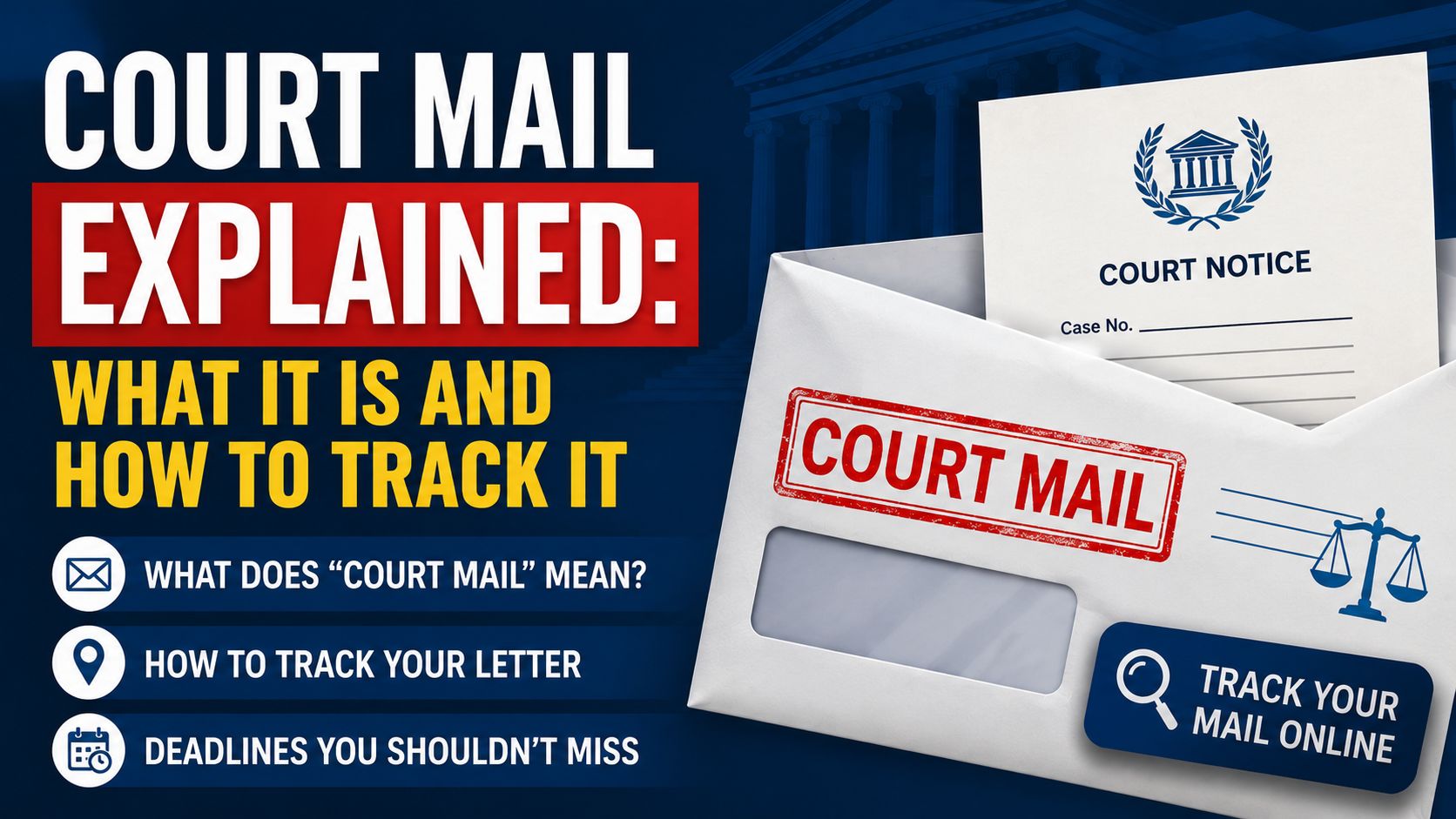
A letter of the category "Judicial" — is a registered correspondence sent by courts and magistrates. There is usually a separate note on the envelope or in the postal notification. By it, postal workers can immediately see that it is not an ordinary registered letter, but a shipment with a short storage period and increased significance.
Inside, there can be various documents:
-
a copy of the court order;
-
a summons to a hearing;
-
a court ruling;
-
a decision or reasoned part;
-
notification regarding an administrative, civil, or arbitration case;
-
materials for debt collection, fines, disputes with a bank, management company, tax authority, or another participant in the process.
The envelope itself does not indicate whether a person is guilty or not. It only shows: the court sent the document to the address that is in the case. Then the most important part begins — deadlines. Sometimes a person receives a notification, postpones going to the post office, and then finds out that the order has already come into effect, the bailiffs have deducted money, and the time for objections has almost expired.
[Image: Postal notification marked "Judicial" with a tracking number in close-up]
Where to get the tracking number and how to check the letter
To track a judicial letter, a tracking number is needed. It is printed on the postal notification, in SMS, push notifications from the Russian Post app, or in the personal account if the shipment has been pulled up by the recipient's data. For domestic shipments, the number usually consists of 14 digits. It is better to enter it without spaces, brackets, and extra symbols.
Checking takes less than a minute:
-
Open the tracking service of the Russian Post.
-
Enter the tracking number from the notification.
-
Look at the latest status.
-
Check the address of the post office and the date of receipt.
-
Take a screenshot of the data if there is a dispute about the deadlines.
The tracking shows the movement of the letter: accepted, sorted, arrived at the post office, awaiting the recipient, delivered, or returned to the sender. This is especially useful for judicial correspondence. The statuses help to understand when the letter arrived at your post office and how much time is left for receipt.
What can be learned from the statuses
| Status | What it means | What to do |
|---|---|---|
| Accepted at the post office | The court has handed over the envelope for dispatch | You can start tracking the movement |
| Arrived at the sorting center | The letter is traveling through logistics | Just check for updates |
| Arrived at the delivery location | The envelope is already at your post office | Go for it as soon as possible |
| Awaiting the recipient | The letter is at the post office | Take your passport and pick it up |
| Unsuccessful delivery attempt | The postman did not find the recipient | Do not wait for a repeat visit |
| Returned to sender | The storage period has expired or the recipient did not receive the letter | Immediately check the case and deadlines |
Postal statuses do not reveal the contents of the envelope. It is impossible to determine exactly what is inside: an order, a summons, or a ruling. However, you can see the sender, route, post office, and date of the key event.
Why judicial correspondence should not be kept "for later"
Such letters have a short storage period. While ordinary registered letters can stay longer, judicial shipments wait for the recipient for a limited time. After that, the post sends the envelope back to the court. For a person, this does not always save the situation. The court may consider the recipient notified if the letter was sent to the correct address, and the person did not come for it without a valid reason.
In simple terms: "I didn't pick it up" does not always work as a defense. There will be a note about the return in the case. The judge will see that the correspondence was sent, and the recipient did not receive it at the post office. After that, the process often continues on its own.
Particularly careful attention is needed with a court order. This is a fast format for collection without a hearing and summons of the parties. It can be used to collect debts for utilities, loans, microloans, taxes, alimony, and other amounts. The debtor has a deadline for objections. If missed — it will be necessary to restore the deadline and prove a valid reason.
How to understand where the letter came from
The notification often shows the sender's index, the name of the court, or at least the city. If the data is scarce, act as follows:
-
check the tracking on the Russian Post website;
-
look at the "sender" line in the shipment card;
-
check the websites of the courts by the place of registration, property address, or place of dispute;
-
visit the GAS "Justice" and search through the websites of magistrates;
-
check the bank of enforcement proceedings of the FSSP if there is a risk of an old debt.
Sometimes the letter comes not to the actual place of residence, but to the registered address. This is a common story: a person rents an apartment, lives in another city, and all judicial correspondence goes to the registration address. Here, a simple checklist is needed: arrange with relatives, enable notifications, periodically check postal shipments and judicial databases.
Computer specialists would say: do not wait for the system to "crash." It is better to set up monitoring in advance. The same goes for judicial mail. One missed envelope can trigger a chain: order, enforcement order, bailiff, card arrest.
What to take with you to the post office
A passport is required for receipt. If the letter came for another person, it will not be issued just like that. A power of attorney or legal basis is needed: for example, documents of a representative of an organization if the recipient is a legal entity.
Before your visit, check the schedule of the post office. Sometimes the letter is already there, but the issuance window does not operate all day. In small post offices, this is especially noticeable: you come after work, and the issuance of registered letters is already closed. You lose a day. For judicial correspondence, a day can be costly.
At the post office, ask for the registered letter marked "Judicial." After receiving it, do not throw away the envelope. It may have important marks: date of dispatch, stamp, identifier, information about the delivery attempt. The envelope will be useful if you have to dispute the deadlines.
What to do after receiving
Do not limit yourself to a cursory glance. Examine the paper immediately.
-
Find the name of the court and the case number.
-
Check who the applicant or plaintiff is.
-
Determine the type of document: order, summons, decision, ruling.
-
Check the dates: issuance, receipt, hearing, response deadline.
-
Take a photo or scan all pages.
-
If necessary, prepare objections, a complaint, a response, or a petition.
If there is a court order inside, do not delay. Objections are usually written briefly: I do not agree with the execution of the order, I ask for cancellation. There is no need to elaborate on the entire position on the dispute for ten pages. The main thing is to meet the deadline and correctly send the document to the court.
If a summons has arrived, check the date of the hearing and the format of participation. Sometimes it is possible to file a petition for a postponement, participation via video link, or consideration without personal appearance. It is better to do this in advance, rather than an hour before the hearing.
Mini-checklist for a calm reaction
| Situation | Risk | Quick action |
| The notification has been at home for several days | The letter may be returned | Pick it up on the nearest working day |
| The tracking shows "return" | The court may consider the notification to have taken place | Find the case and request copies |
| There is a court order inside | Deductions through bailiffs may occur | File objections |
| A hearing has been scheduled | The case may be considered without you | Prepare a position or petition |
| The letter came to the old registration address | The correspondence may get lost again | Set up address control and notifications |
If the letter has already been sent back
There is no need to panic. But action must be taken quickly. First, find the court and the case number. If the tracking shows the sender, it is easier. If the sender is not visible, check the judicial districts by the registration address, the district court, the arbitration court for business disputes, and databases by surname.
Next, you can contact the clerk's office. Be specific: full name, address, approximate date of dispatch, tracking number if available. Ask for the case number and how to obtain copies of documents. Sometimes papers are available through electronic services, sometimes a request is needed.
If the deadline has already passed, prepare two documents: the main procedural document and a request to restore the deadline. You will have to explain the reason. Not just any words will do, but confirmations: business trip, hospital, relocation, delivery failure, incorrect address, absence of notification. Courts do not like bare phrases. Proofs are needed.
Common mistakes
The most harmful mistake is thinking that a judicial letter can be ignored. As if, no signature — no problem. In practice, the problem often becomes bigger.
Another mistake is only looking at the paper notification. It can get lost in the mailbox, end up with neighbors, or arrive late. Tracking is more reliable: it shows the movement of the shipment in the system.
The third mistake is throwing away the envelope. The internal sheets are important, but the envelope sometimes resolves disputes about dates. Keep it at least until the end of the case.
The fourth is waiting for a lawyer without picking up the letter. A lawyer can help with the position, but first, it is necessary to understand what exactly the court sent. Without the document, the specialist works blindly.
In short
A letter of the category "Judicial" — is a signal to act, not a reason to hide. Take the tracking number, check the status, pick up the envelope with your passport, and immediately examine the dates. If the letter has already been returned, find the case through the court or clerk's office and request copies. The sooner you see the document, the more options will remain: cancel the order, prepare a response, postpone the hearing, or prove your position without unnecessary fuss.