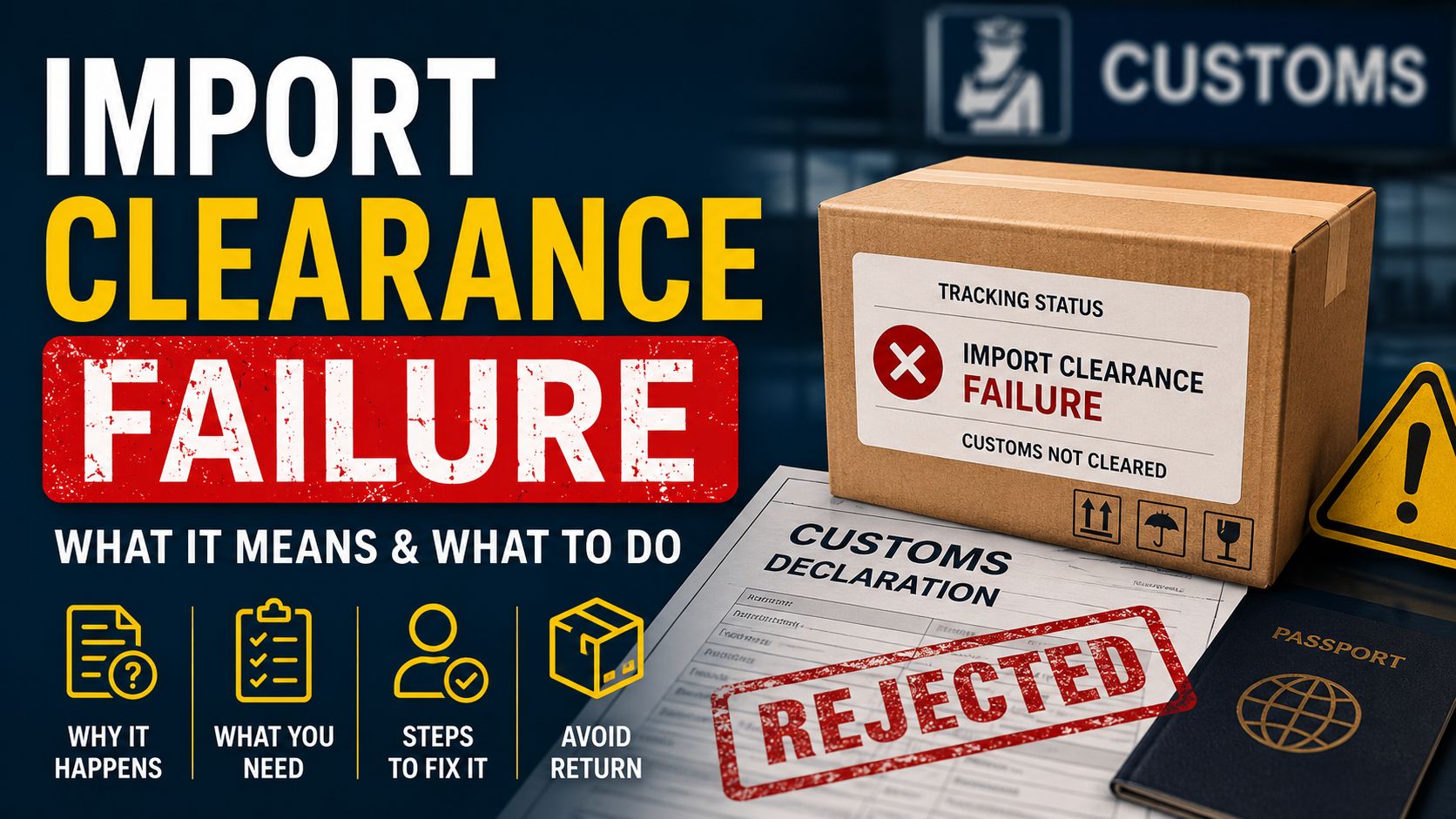
The status "Import clearance failure" means that the international package did not pass import customs clearance in the recipient's country. The cargo has already reached the border or customs terminal, but the system did not release it further along the route.
In simple terms, the package is not lost. It is stuck at the verification stage. The customs, carrier, or broker is missing something: data, documents, payment of duties, correct description of the goods, or confirmation from the recipient.
This status is most commonly encountered with international shipments from DHL, FedEx, UPS, EMS, postal services, and logistics aggregators. The wording may differ, but the meaning is the same: the import clearance has failed, and the shipment cannot proceed to delivery within the country.
Why the package does not pass import clearance
Customs checks not only the fact of delivery. It verifies the description of the goods, value, country of origin, recipient, weight, product code, import limits, and prohibitions. If there is incorrect information somewhere, the system halts the tracking.
The main reasons are as follows:
| Reason for the status | What usually happened | Who resolves the issue |
|---|---|---|
| Incorrect description of the goods | The declaration was written too generally: gift, accessories, parts | Sender or seller |
| Missing documents | No invoice, receipt, passport, TIN, or order link | Recipient, seller, broker |
| Error in recipient's data | Incorrect name, phone, address, postal code | Recipient or delivery service |
| Duties not paid | Customs has assessed a payment, but it has not been made | Recipient |
| Goods are subject to restrictions | Certificates, permits are needed, or the goods cannot be imported | Recipient, broker, customs |
| Value raises questions | The price in the declaration looks understated | Recipient or seller |
| The package is going to a legal entity | Details, contract, payment document, HS code are needed | Receiving company |
The most common mistake is a weak description of the goods. For example, the seller sent electronics and wrote "parts" in the declaration. For customs, this is almost meaningless. They need to understand what is inside: a board, cable, adapter, screen, battery, module, tool, or spare part.
Is this a critical error or a common delay?
The status of import clearance failure does not itself mean that the package has been confiscated. In most cases, this is a working delay. The customs broker or carrier requests the missing data, after which the shipment is re-launched for clearance.
A bad sign is if additional statuses appear nearby:
-
returned to sender;
-
held by customs;
-
customs exception;
-
clearance delay;
-
shipment on hold;
-
awaiting import documents;
-
receiver action required.
If the tracking indicates that action is required from the recipient, do not delay. There are storage deadlines at customs warehouses. When the recipient is silent, the carrier may arrange for the return of the shipment to the sender or transfer the cargo to separate storage with a fee for each day.
What to do as a recipient step by step
The first action is to open the full tracking history. Not just in the store's app, but on the carrier's website. Marketplaces often show a short version of the status, without details. Courier services usually have more information: document requests, broker number, comments on the declaration.
Then proceed step by step.
1. Check if there is a request from the carrier
Look at SMS, email, personal account of the delivery service. Sometimes the email goes to spam, and the tracking just shows import clearance failure. The email may request:
-
passport details;
-
TIN;
-
link to the product;
-
order screenshot;
-
payment receipt;
-
description of the goods in Russian or English;
-
confirmation of value;
-
consent to broker clearance.
If the carrier has already sent a form, fill it out carefully. Errors in the name, document number, or address will send the package back into a halt.
2. Prepare documents for the order
For a private recipient, a basic set is usually sufficient:
-
order screenshot from the store;
-
receipt or payment statement;
-
tracking number;
-
description of the goods;
-
passport details, if requested;
-
TIN, if needed for clearance;
-
link to the product card.
Do not try to "undervalue" the cost below the actual price. Customs sees typical prices and easily catches strange figures. If the goods cost 120 dollars, and the declaration states 5 dollars, the tracking may hang for a long time.
3. Contact the carrier's support
Writing to the seller is useful, but it is faster to go to the one who holds the cargo for clearance. This could be DHL, FedEx, UPS, EMS, national postal service, or local broker.
In your inquiry, specify:
-
tracking number;
-
recipient's full name;
-
country and city of delivery;
-
status in tracking;
-
date the error appeared;
-
question: what documents are needed for the release of the package.
Be concise. Support does not like long messages. Specificity is needed: "The tracking shows Import clearance failure. Please let me know what data is required for passing import customs clearance."
4. Check if duty payment is required
If the value of the goods exceeds the duty-free import limit or the goods are going through a commercial carrier, customs may assess a payment. As long as the duty, VAT, or broker fee is not paid, the package will not proceed further.
Usually, the carrier provides a link for payment or instructions. Do not click on random links from messengers. Access through the official website of the delivery service or personal account.
5. Ask the seller to correct the documents
If the problem is with the invoice, description of the goods, or declaration, the recipient may not always be able to fix everything themselves. Then the sender is needed. Ask the seller to send a correct invoice with a proper description of the goods, value, currency, quantity, and shipment details.
For marketplaces, you can open a dispute or ticket, but do not immediately push for a refund. Sometimes just one corrected document is enough, and the package clears customs in a couple of days.
What to write to the seller or sender
You can use a simple template:
"Hello. The tracking number shows the status Import clearance failure. The carrier reports a problem with import clearance. Please check the customs declaration and send a correct invoice with the description of the goods, value, quantity, and tracking number. If the carrier needs additional information from the sender, please provide it as soon as possible."
For an English-speaking seller:
"Hello. My tracking number shows Import clearance failure. The shipment has a customs clearance issue in the destination country. Please check the customs declaration and send a correct invoice with product description, value, quantity, and tracking number. If the carrier needs any additional sender information, please provide it as soon as possible."
When there is a risk of return to sender
The risk increases if the status does not change for several days, and the carrier does not receive documents. Such situations develop especially quickly with express delivery: the cargo is sitting at the terminal, the broker is waiting for a response, and the storage time is ticking.
Return is possible in the following situations:
-
the recipient does not respond to requests;
-
the goods are prohibited for import;
-
there is no required permit or certificate;
-
the seller provided false information;
-
duty is not paid;
-
the recipient refused broker clearance;
-
customs does not accept the declared value.
If the tracking already shows return or returned to sender, it is harder to fix the situation. Sometimes the cargo can still be stopped through the carrier, but more often it goes back through the chain.
How Import clearance failure differs from Clearance delay
These statuses are similar, but there is a difference between them.
| Status | Meaning | How urgently to react |
| Clearance delay | Processing is delayed, the process is still ongoing | Medium |
| Import clearance failure | Import clearance did not pass | High |
| Held by customs | The package is held by customs | High |
| Receiver action required | Action is required from the recipient | Very high |
| Returned to sender | The shipment is being returned to the seller | Critical |
Clearance delay often resolves itself if there is a queue at the terminal or the broker is still processing documents. Import clearance failure already indicates a failure. It is better not to wait for the tracking to "revive itself."
Which goods are more likely to get stuck at customs
Problems are more likely to arise not with t-shirts or simple accessories, but with goods where customs wants more clarity.
At risk are:
-
electronics and boards;
-
batteries and accumulators;
-
radio modules, routers, antennas;
-
cosmetics and dietary supplements;
-
medications;
-
auto parts;
-
tools;
-
branded items;
-
high-value goods;
-
shipments of identical goods.
If there are five identical gadgets in the package, customs may decide that this is a commercial import. Even if you ordered them "for yourself and friends." Then other documents may be needed, and sometimes clearance as for a legal entity.
What to do if the carrier is silent
It can happen that the tracking shows an error, there are no emails, the support phone hangs up, and the chat responds with a template. In this case, a parallel scheme helps.
Take three actions:
-
Write to the carrier's support through the official website.
-
Contact the seller and ask them to check requests from logistics.
-
Check the tracking on third-party tracking services and on the website of the destination country's postal service.
Sometimes one service shows only "Import clearance failure," while another reveals a normal hint: "missing invoice," "tax payment required," "incorrect receiver data." This line saves time immediately.
What not to do
Do not wait two weeks if the status is already asking for action. Customs will not guess your TIN, will not find the payment receipt, and will not correct the incorrect invoice for the seller.
Do not send documents in random chats if you are not sure you are communicating with the carrier. Check passport details and payment links through the official website.
Do not change the figures. If in the first email you stated one value, and then another, the broker may request additional confirmations. It is better to provide a proper receipt and order link right away.
Do not open a dispute too early if the package can actually be released. A dispute is needed when the seller ignores requests, provided false documents, or the cargo has already gone back.
How to understand that the problem is resolved
After sending the data, the status usually does not change immediately. First, the broker accepts the documents, then forwards them to customs, and then the system updates the tracking.
Good signs:
-
customs clearance processing;
-
import clearance completed;
-
released from customs;
-
handed over to local delivery;
-
out for delivery;
-
arrived at delivery facility.
After being released from customs, the package proceeds along the usual route: sorting, local warehouse, courier, or pickup point. If several working days have passed after sending the documents and the tracking is dead, write to the carrier again and request the status of the customs case.
In short: what to do in case of Import clearance failure
The status of import clearance failure indicates a failure in import customs clearance. The package is not lost, but without action, it may get stuck or go back to the sender.
The working order is as follows: open the tracking on the carrier's website, check for requests in email and SMS, prepare documents, contact support, pay duties if necessary, and ask the seller to correct the invoice. The faster you provide customs with the correct data, the higher the chance that the shipment will be released without return.