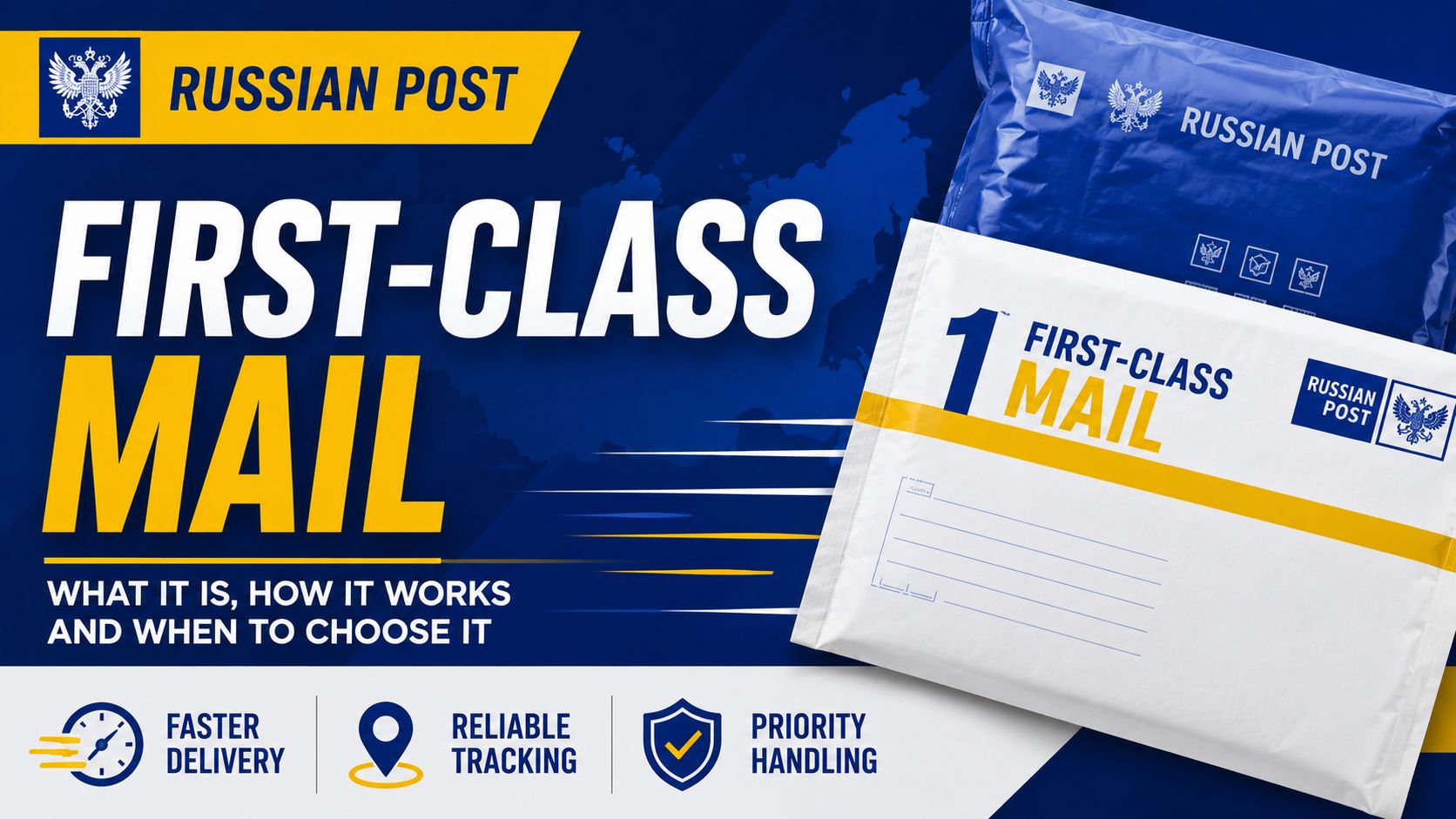
First class mail from Russian Post is chosen when regular shipping seems too slow, and courier delivery is already too expensive and complicated. This format is suitable for documents, business papers, printed materials, and small parcels that need to be delivered faster than the standard route.
First class is not just a pretty yellow stripe on the envelope. The shipment receives priority processing, goes through sorting faster, and is more likely to take an expedited route. In postal terms, this means: it spends less time in bags, gets to the next hub faster, and is better tracked.
What does first class shipment mean
First class is an expedited shipping format within Russia. It is used for letters, parcels, and some packages if the contents comply with Russian Post rules. Most often, it is used to send papers, contracts, applications, books, catalogs, photographs, small goods, and other compact items.
The main idea is simple: the shipment does not go in the slowest general flow. The post processes it as a priority. Hence the difference in delivery times.
First class is often used when you need to send:
-
a contract, act, application, or certificate;
-
documents to a university, court, bank, or government agency;
-
a book, magazine, catalog, or manual;
-
photos, postcards, or prints;
-
a small item, if it fits the format;
-
documents with tracking and delivery confirmation.
For the sender, the process is familiar: you arrive at the post office, choose the type of shipment, pay the fee, and take the receipt. The receipt will have a tracking number if the shipment is registered. It’s best to save it right away. Later, it saves nerves.
How first class differs from regular mail
Regular letters or parcels go through the standard route. They are accepted, sorted, transported, and delivered without expedited priority. First class is processed faster. This is felt more on long distances, especially between regions.
There is another practical point. First class shipments are often chosen not only for speed but also for control. The registered format allows tracking the movement, and the recipient signs upon delivery. This is a practical topic for documents.
| Parameter | Regular shipment | First class shipment |
|---|---|---|
| Speed | Standard | Expedited |
| Processing | In the general flow | With priority |
| Tracking | Not always available | Available for registered formats |
| Price | Lower | Higher |
| Best scenario | Non-urgent letters and simple prints | Documents, parcels, small attachments with deadlines |
| Risk of delays | Depends on the route | Also exists, but the route is usually faster |
First class does not guarantee delivery "minute by minute." The post still depends on sorting centers, weather, holidays, workload of post offices, and distance. But in regular postal logistics, this is one of the most understandable ways to expedite shipping.
What types of first class shipments are there
At the counter, you will most often encounter three options: first class letter, first class parcel, and first class package. The names are similar, but the contents are different. Many get confused here.
First class letter
A first class letter is suitable for written correspondence and documents. It is a good option for contracts, certificates, applications, copies of documents, claims, notifications.
If you need delivery confirmation, you take a registered first class letter. If the sender wants to indicate the value of the contents, they arrange a valuable letter. For legal documents, this combination looks more reasonable than a simple envelope: there is tracking, there is a receipt, there is a record in the system.
Do not stuff the letter with just anything. A thick envelope with a flash drive, souvenir, and charger may not be accepted as a letter. A different format is needed for items.
First class parcel
A first class parcel is used for printed materials and more substantial paper contents. Books, magazines, catalogs, manuscripts, photographs, educational materials—all of these are usually closer to a parcel than to a letter.
Postal workers often simply call such contents "prints." If you have a stack of papers, a manual, or a book, do not try to cram everything into an envelope like a letter. It’s easier to arrange a parcel right away. This way, there are fewer questions at acceptance.
First class package
A first class package is needed for small goods and items if they are allowed for shipping. This is already a box, bag, normal packaging, sometimes with declared value and inventory.
This option is suitable for compact items: accessories, small parts, souvenirs, goods from online orders. It’s best to check the weight and dimensions in advance using the Russian Post calculator or directly at the post office. If the box is large, the operator will offer a regular package or another rate.
When first class is really needed
Paying for expedited service does not always make sense. If a postcard can calmly take a week, a regular letter will suffice. If the document is needed quickly by the recipient, first class already looks logical.
Good cases for sending first class:
-
The recipient needs documents in the coming days.
-
The shipment is going to another region.
-
A tracking number is needed for control.
-
The contents are small but valuable in meaning.
-
Regular delivery on the route takes too long.
-
Delivery confirmation is needed.
There are also reverse situations. A heavy item without urgency is better sent as a regular package. A fragile item should be packed as if the box will go through several sortings, because it will. First class speeds up the route but does not turn logistics into careful manual delivery.
How to arrange a shipment without unnecessary running around
Before heading to the post office, figure out three things: what’s inside, what the weight is, and whether delivery confirmation is needed. This helps avoid getting stuck at the window when there’s already a queue behind you.
The order is simple:
-
Prepare the contents.
-
Choose the format: letter, parcel, or package.
-
Pack it so that nothing rattles.
-
Write the address legibly: postal code, city, street, house, apartment, full name.
-
Tell the operator that you need first class shipping.
-
Clarify whether a registered or valuable format is needed.
-
Pay and take the receipt with the tracking number.
It’s better not to guess the postal code. Sorting first looks at the numbers and only then at the address. An error in the postal code can send the letter on an unnecessary round. Later, the tracking will show the favorite "arrived at the sorting center," and the sender will start wondering why the package went the wrong way.
Packaging: a small detail that matters
Documents are better placed in a sturdy envelope. A stack of papers should go in a postal bag. A small item should be in a box with filler. Bubble wrap, paper, and soft padding inside the box help survive the journey without crumpled corners and cracked plastic.
Do not seal the packaging tightly if the operator needs to check the contents. Sometimes at acceptance, they ask to show the contents, especially if the format raises questions. This is a normal working situation, not a nitpick.
For fragile items, first class does not provide armor. Sorting, bags, containers, and tapes—all remain. If there is glass, electronics, or a small part with sharp edges inside, the packaging must hold the load.
[Image: Neatly packed documents and a small package before sending at the post office]
What cannot be sent by first class
First class does not cancel postal prohibitions. It is not allowed to send dangerous substances, weapons, explosives and flammable materials, narcotic drugs, perishable products, and other prohibited contents.
Do not try to disguise an item as documents. If there is a product inside, arrange a package or another suitable format. If there are papers inside—use a letter or parcel. The more honestly the type of shipment is chosen, the less risk there is that the package will be turned away at acceptance or a dispute will arise later.
What to choose: letter, parcel, package, or EMS
The choice depends not on the desire to "hurry up," but on the contents. Papers go one way, printed materials another, and items a third.
| Task | Suitable option |
| Send a contract to another city | Registered first class letter |
| Send a certificate or application | First class letter |
| Send a book or catalog | First class parcel |
| Forward a small item | First class package |
| Send a heavy item without urgency | Regular package |
| Need courier delivery | EMS |
| Send a simple postcard without haste | Regular letter |
If in doubt, tell the operator what exactly is inside. Not just "documents," but "a stack of documents," "a book," "a flash drive," "a small item." For the post, these are different categories.
Common mistakes of senders
The first mistake is choosing first class just because of the name. Expediting costs money, so first assess the urgency.
The second is confusing a letter and a parcel. If the contents are thick, heavy, or resemble a book, an envelope will no longer suffice.
The third is throwing away the receipt. Without tracking, it is harder to check the shipment's path and prove the fact of acceptance.
The fourth is writing the address by hand carelessly. The post should not have to guess the building, structure, and apartment. A clear address saves days.
The fifth is weak packaging. Even a small package goes through sorting, not riding on a soft pillow.
In short
First class mail from Russian Post is an expedited format for documents, printed materials, and small parcels. It is chosen when a faster route, tracking, and predictable processing are needed.
For papers, a first class letter is suitable; for books and catalogs—a parcel; for small items—a package. Look at the type of contents, weight, dimensions, and urgency. Then first class will work effectively: without unnecessary overpayment, reprocessing at the window, and nervously refreshing the tracking every five minutes.