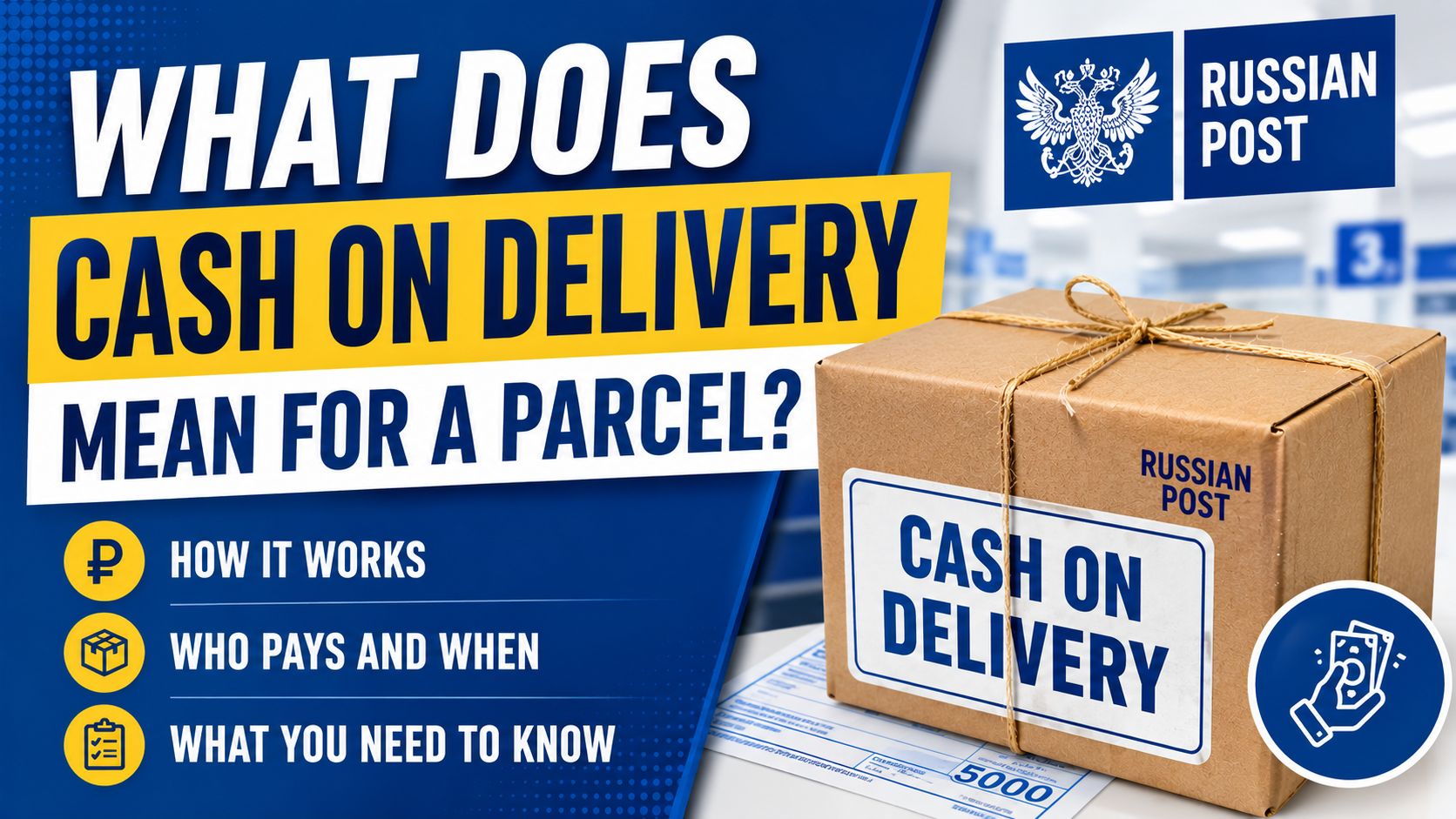
Cash on delivery is a shipment for which the recipient pays upon receipt. Not in advance to the seller's card, not by "trust" transfer, but directly at the post office or through an available payment method offered by Russian Post. After payment, the post office hands over the shipment and transfers the money to the sender.
In everyday life, this scheme is often called "cash on delivery." The word is short, but it represents a quite understandable mechanism: the goods travel to the buyer, and the money goes to the seller only after receipt. Therefore, cash on delivery is often used by Russian Post for orders from small sellers, purchases from individuals, shipping goods between cities, and transactions where the parties do not want to work on full prepayment.
How cash on delivery works at Russian Post
The sender registers the package as a valuable shipment and specifies the amount that the recipient must pay. This amount cannot exceed the declared value. If the item is valued at 4000 rubles, it will not be possible to set the cash on delivery at 7000 rubles.
Then everything goes through the usual postal chain:
-
The sender packs the goods and brings them to the post office.
-
The operator registers the valuable package with cash on delivery.
-
The sender is given a receipt and a tracking number.
-
The recipient tracks the movement of the shipment.
-
After arrival, the person comes for the package.
-
The post office accepts payment and hands over the box.
-
The money is transferred to the sender.
The scheme looks simple. And it is. But there are plenty of nuances, especially if a person is encountering payment upon receipt for the first time.
How cash on delivery differs from a regular package
A regular package is most often already paid for. The recipient simply comes, shows their passport or code, picks up the shipment, and leaves. With cash on delivery, the box will not be handed over without payment.
| Parameter | Regular package | Package with cash on delivery |
|---|---|---|
| When payment for the goods is made | Before shipping or separately | Upon receipt |
| Who receives the money | Seller directly or store | Russian Post |
| Is declared value needed | Not always | Yes |
| Can it be picked up without payment | Yes, if there are no fees | No |
| Common scenario | Gifts, documents, paid orders | Purchases from individuals, goods from private sellers |
The main advantage for the buyer is that there is no need to send money to an unfamiliar person right away. The main advantage for the seller is that the post office will not hand over the shipment for free. This is not a shield against all risks, but a working insurance against the banal situation of "sent the money, no package."
Can you check the package before payment
This is where confusion often begins. Many think: since payment is upon receipt, you can calmly open the box, turn on the device, try on the item, assess the quality, and then decide whether to pay or not. In reality, everything is stricter.
The recipient can pay attention to the condition of the packaging, weight, signs of tampering, and sender's details. If there is an inventory list, it is checked according to postal rules. But the post office is not a showroom or a service center. The operator will not wait while the buyer tests the smartphone, inserts the SIM card, runs the laptop, or checks every detail of the set.
Before payment, it is worth checking:
-
if the tracking number matches;
-
if there are any obvious damages to the packaging;
-
if the box has been opened on the way;
-
if the weight is similar to what was expected;
-
if there is an inventory list;
-
if the amount matches the agreement.
If the box is crumpled, wrapped in strange tape, or weighs suspiciously little, do not rush to pay. Ask the operator to explain the procedure for checking and refusing. Calmly, without fuss. In the post office, documents decide everything, not a loud voice.
Who pays for delivery, commission, and transfer
In cash on delivery, there are several amounts that can easily be mixed into one pile. Because of this, unpleasant surprises often arise at the delivery window.
Usually, the calculation may include:
-
cost of the goods;
-
delivery price;
-
fee for declared value;
-
commission for transferring money to the sender;
-
packaging, if purchased at the post office.
The seller can include postal expenses in the total amount or ask the buyer to pay them separately. Both options are normal if the parties agreed in advance. A bad option is when the buyer thinks they will pay 2500 rubles, but at the post office sees 2900 rubles and starts to find out where the difference came from.
The correct question to the seller is: "How much will it be in total upon receipt?" Not "how much is the item," but the entire amount. It’s simpler that way.
When cash on delivery is really convenient
Cash on delivery is well-suited for transactions where there is no trust at the level of "transferred and forgot." For example, a person buys a rare book, spare part, baby stroller, collectible item, tool, clothing, or small electronics from a seller in another city.
It is convenient for the buyer because they do not pay the entire amount before shipping. It is convenient for the sender because the money is tied to the delivery of the package. The post office acts as an intermediary: it accepts the shipment, delivers it, takes payment, and transfers the funds.
But there are no miracles. If the seller sent the wrong item, cash on delivery will not resolve the dispute in a minute. Here, correspondence, photos, receipts, inventory lists, and return rules are important. Therefore, before the transaction, it is better to ask for real photos of the item, a video of the packaging, and an accurate description of the condition. Especially if the amount is significant.
What the sender should do
The sender should not treat cash on delivery as a "sent and forgot" button. If there is an error in the address, weak packaging, or the amount is incorrectly stated, problems will arise quickly.
Before handing over the package, check:
-
Recipient's full name.
-
Index and address of the post office.
-
Recipient's phone number.
-
Amount of cash on delivery.
-
Declared value.
-
Quality of packaging.
-
Presence of an inventory list if the item is expensive.
Packaging is a separate pain. The box should not rattle, crumple, or crunch. Empty spaces should be filled with paper, bubble wrap, or other filler. Fragile items need to be secured tightly. Postal workers will not carry each box like a vase from a museum: sorting, bags, carts, shelves—all this is the usual road for the shipment.
After registration, the sender should send the buyer the tracking number and a photo of the receipt. This is normal practice. Not paranoia, but a careful transaction.
What the recipient should do
The recipient should also not go to the post office on autopilot. First, check the tracking, amount, and sender's details. Bring your passport or another document if it is needed for pickup. If you are using an app, open the barcode or receipt code in advance.
At the counter, do not rush. Look at the packaging. Compare the amount. Ask if there is an inventory list. If everything matches, pay and pick up the package. After payment, keep the receipt, box, and labels at least until you check the item at home.
If the item is expensive, take a photo of the packaging before opening. Even better—record a short unboxing video. Yes, it sounds tedious. But in case of a dispute, it works better than the phrase "it was not what I expected."
Common mistakes of buyers and sellers
Buyers most often make mistakes in three areas. First—believing that cash on delivery guarantees the quality of the goods. No, it only guarantees payment upon receipt. Second—not clarifying the total amount. Third—not keeping the receipt and correspondence.
Sellers also make mistakes. They indicate the wrong index, skimp on packaging, do not warn about the commission, forget about the declared value. Sometimes they set the amount by eye and then wonder why the buyer refuses to pick up the shipment.
To ensure a smooth transaction, the following should be agreed upon before shipping:
-
the exact amount to be paid;
-
who pays for delivery;
-
whether the commission is included in the price;
-
what exactly is in the box;
-
whether there will be an inventory list;
-
when the sender will provide the tracking number.
Five minutes of correspondence before shipping saves an hour of nerves after arrival.
When it is better not to use cash on delivery
If you are buying from a large store with a clear return policy, it is sometimes easier to pay for the order online. If the amount is large, it is safer to use a secure transaction on the platform or agree on a payment method with normal return rules.
Cash on delivery should not be chosen if the seller is pressuring, rushing, refusing to send photos, getting confused in the description of the goods, or asking for "a small prepayment for reservation" to a personal card. This is no longer a postal issue. It smells like a murky scheme.
For regular transactions, a package with cash on delivery remains a convenient tool. The buyer pays upon receipt, the sender receives money through Russian Post, and the movement is visible via tracking. If the amount, delivery, commission, and condition of the goods are agreed upon in advance, cash on delivery works smoothly—without unnecessary running around and disputes at the delivery window.