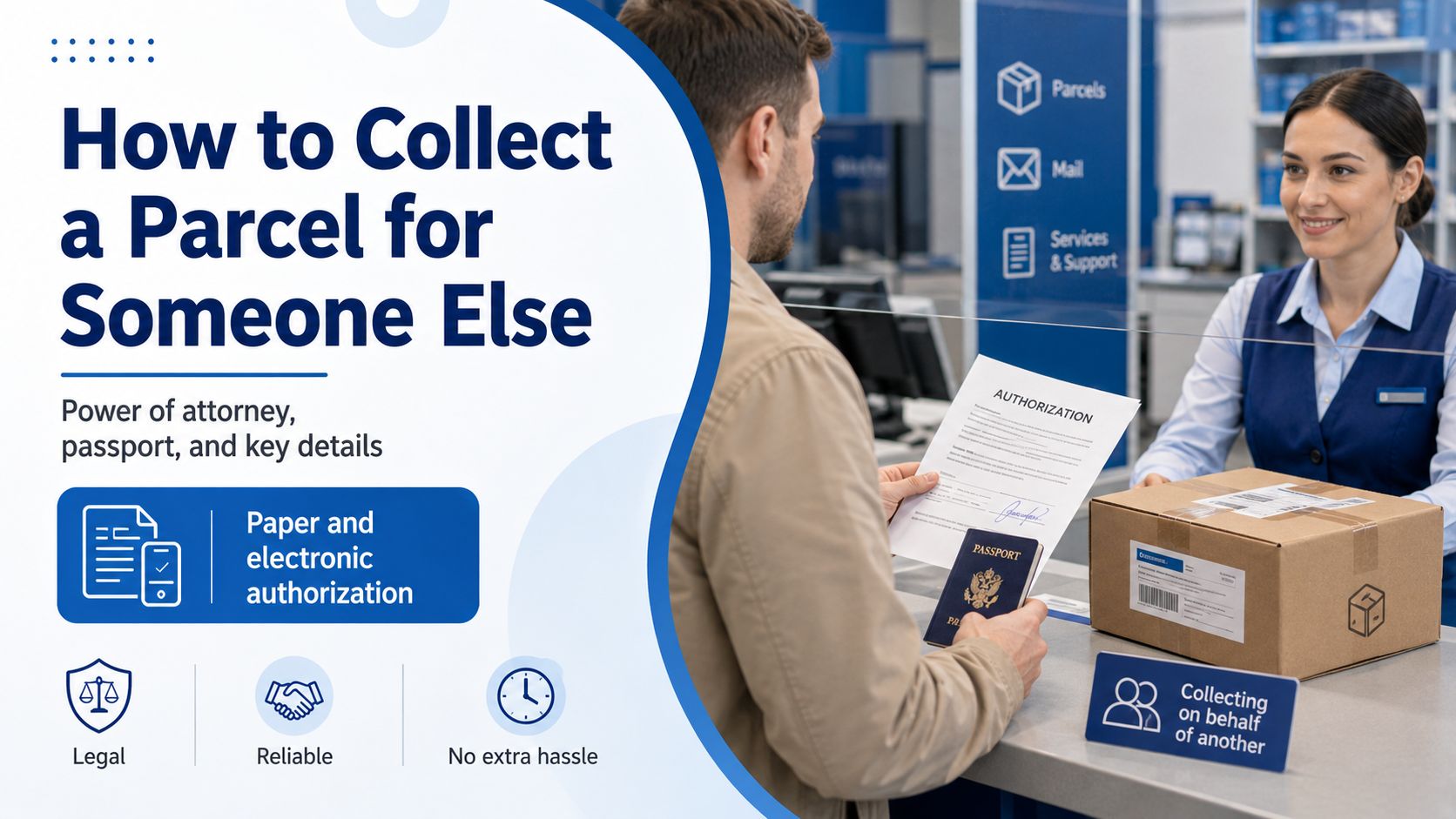
Russian Post issues parcels not to anyone who simply knows the tracking number, but to those who have confirmed their right to receive it. If the parcel is addressed to another person, the operator checks not only the tracking number but also the documents.
A common situation: a wife asks her husband to pick up a parcel, a son goes to collect his mother's shipment, an employee receives correspondence for the company, a neighbor helps an elderly person. In all these cases, the scheme works if the powers are arranged in advance.
Simply coming with the recipient's passport is not allowed. A stranger's passport also does not solve the issue. The operator must see that the recipient has allowed another person to collect the shipment.
In practice, there are two main options:
-
Paper power of attorney.
-
Electronic power of attorney through the Russian Post service.
Both methods are suitable for everyday situations, but there are nuances depending on the type of shipment. Especially if it concerns cash on delivery, customs, returns, or reshipments.
What documents are needed at the post office
To collect a parcel for another person, the authorized person usually needs:
-
their own passport;
-
tracking number, notification, or alert from the app;
-
power of attorney from the recipient;
-
phone number, if the issuance is done via code or through the electronic service.
The passport must belong to the person who came to the post office. The operator verifies the identity of the authorized person, not just looking at the recipient's details.
If the power of attorney is paper, it must contain the details of the recipient and the person collecting the shipment. If the power of attorney is electronic, the operator checks it in the system. There is no need to print a paper document.
For small packages, registered letters, parcels, and EMS, the logic is similar: without confirmed rights to receive someone else's shipment, it will not be handed over. The postal worker will not take risks because issuing to the wrong person is considered a mistake by the post office.
Paper power of attorney: when it is suitable
A paper power of attorney is convenient if the recipient does not use the personal account of the Russian Post, cannot arrange electronic access, or wants to transfer the right to receive in advance.
It is better to specify in the document:
| What to write | Why it is needed |
|---|---|
| Full name of the recipient | to clarify who issued the permission |
| Passport details of the recipient | for identification of the principal |
| Full name of the authorized person | who exactly can collect the parcel |
| Passport details of the authorized person | the operator will verify them with the passport |
| Right to receive postal shipments | to avoid disputes over the wording |
| Validity period | without a validity period, the document may not be accepted or they may start to clarify |
| Date and signature | without this, the power of attorney looks incomplete |
The wording can be made simple: I authorize to receive postal shipments, parcels, letters, and other correspondence at the Russian Post offices. The clearer it is written, the fewer questions the operator will have.
For one-time collection, a specific tracking number can be indicated. For regular collection, the right to receive all postal shipments within a chosen period can be specified. For example, for a month, six months, or a year.
A notarized power of attorney is not always necessary. For regular postal shipments, a simple written form is often used. But if the shipment is expensive, disputed, involves money, a company, or legally significant correspondence, it is better not to skimp on the paperwork. Here, an extra "homemade" document can derail the entire scheme.
Electronic power of attorney: the fastest option
An electronic power of attorney removes the main headache: there is no need to write the document by hand, look for a printer, and argue about whether the paper is correctly formatted. The recipient creates the power of attorney in their personal account or the Russian Post app, specifies the phone number of the authorized person and the validity period.
Then the person going to collect the parcel comes to the post office with their passport. The operator sees the power of attorney in the system and issues the shipment if it meets the service conditions.
This scheme is convenient when you need to quickly pick up a parcel for a relative or acquaintance. Especially if the recipient is in another city, at work, sick, or simply cannot make it before the post office closes.
The procedure is simple:
-
The recipient logs into their personal account on the Russian Post website.
-
Opens the electronic power of attorney section.
-
Enters the phone number of the authorized person.
-
Selects the validity period.
-
Confirms the arrangement.
-
The authorized person comes to the post office with their passport.
At the post office, there is no need to show the recipient's passport. The passport of the person collecting the shipment is required. This is a common mistake: people take someone else's document and forget their own at home. In such a situation, the postal worker will not be able to conduct the issuance properly.
When the electronic power of attorney will not work
The electronic power of attorney is not suitable for all shipments. A parcel may not be issued under it if there are additional actions required from the recipient.
Most often, problems arise in the following cases:
| Type of shipment | Why they may refuse |
| Cash on delivery | the shipment needs to be paid for, and issuance under the electronic power of attorney is limited |
| Customs payment | the participation of the addressee or separate processing is required |
| Customs notification | personal interaction with documents may be needed |
| Return | the shipment follows a special processing logic |
| Reshipment | the system may not allow issuance under the electronic power of attorney |
| Disputed shipment | the operator will ask for a paper power of attorney or the addressee themselves |
If a parcel from an online store is sent with payment upon receipt, check the type of shipment in advance. Otherwise, a person will come to the post office, stand in line, and then hear a refusal. Unpleasant. But the operator is not being difficult; they are working according to regulations.
Can you collect a parcel for a relative without a power of attorney
Being related does not automatically give the right to collect someone else's shipment. A husband cannot automatically collect his wife's parcel. A daughter cannot just take her father's shipment. Even if they share the same last name, that is not enough for the operator.
The post office does not verify family relationships based on words. They need a legal basis: a power of attorney, legal representation, or another document that confirms the right to act on behalf of the recipient.
Exceptions exist for minors, guardians, and representatives of organizations, but documents are also required there. For example, a parent can act on behalf of a child, but the operator has the right to request confirmation. An employee of a company will need a power of attorney from the legal entity or a document that confirms their authority.
The cleanest way for a regular household task is to arrange a power of attorney. It is faster than arguing at the issuance window.
What to do if the parcel arrived under an old surname or with an error
If there is an error in the recipient's full name, the issuance may be delayed. Minor typos sometimes pass if the operator sees that the details clearly belong to one person. But when the last name, first name, or patronymic differs, the post office may request additional documents.
If a person has changed their last name, a document confirming the name change will be useful: a marriage certificate, divorce decree, or name change certificate. If another person is collecting on behalf of such a recipient, the task becomes more complicated: a power of attorney with current details and a document linking the old and new details of the recipient will be needed.
In case of an error in the address or full name, it is better not to delay. Check the tracking, status, post office index, and recipient details. If the shipment is still in transit, sometimes it is easier to contact the sender and clarify whether the details can be corrected through a statement.
Why a post office may refuse to issue someone else's parcel
Refusal is most often related not to the operator's mood, but to the documents. The postal worker sees a risk and does not issue the shipment until there is a proper basis.
Typical reasons for refusal:
-
no power of attorney;
-
power of attorney without a date or signature;
-
passport details in the document do not match;
-
the power of attorney is expired;
-
the person came without their own passport;
-
the shipment is not suitable for electronic power of attorney;
-
the recipient is indicated with an error;
-
the shipment requires payment or customs clearance;
-
the parcel has already been sent for return.
There are also purely technical issues. For example, the electronic power of attorney is arranged, but the authorized person indicated a different phone number, changed their passport, or did not confirm the details. In the post office, this appears as "the system does not see the right to receive".
How to prepare to avoid wasting time
Before going to the post office, do a mini-check. It takes a couple of minutes but saves you from an unnecessary trip.
Check:
-
Status by tracking number. The parcel should be ready for issuance.
-
Address of the post office. Sometimes the shipment is not where the person expected it to be.
-
Type of parcel. Cash on delivery and customs payments are better clarified in advance.
-
Storage period. If the period is almost up, act faster.
-
Details of the power of attorney. Full name, passport, date, validity period.
-
Passport of the authorized person. Without it, the issuance window will not help.
If the shipment is valuable, take more confirmations with you: tracking, notification, screenshot from the app, copy of the power of attorney, contacts of the recipient. Not all of this is mandatory, but in a disputed situation, extra information speeds up the resolution.
Short reminder for the recipient and the authorized person
The recipient needs to decide in advance which method is more convenient: paper or electronic power of attorney. If the parcel is ordinary, without payments and customs, the electronic power of attorney is usually faster. If the shipment is complex, expensive, or involves payment, it is safer to prepare a paper document with proper wording.
The authorized person needs to take their passport and know the tracking number. Not the recipient's passport. Not a photo of the passport in a messenger. Their own original document.
The working scheme looks like this:
-
the recipient arranges the power of attorney;
-
the authorized person checks the status of the parcel;
-
takes their passport;
-
comes to the right post office;
-
names the tracking number or shows the notification;
-
receives the shipment and signs for the issuance.
It is possible to collect a parcel for another person if you do not go to the post office "on a whim". The main principle is simple: the Russian Post must understand to whom it is issuing the shipment and why this person has the right to collect it. When the documents are properly gathered, the issuance goes smoothly without unnecessary stress.