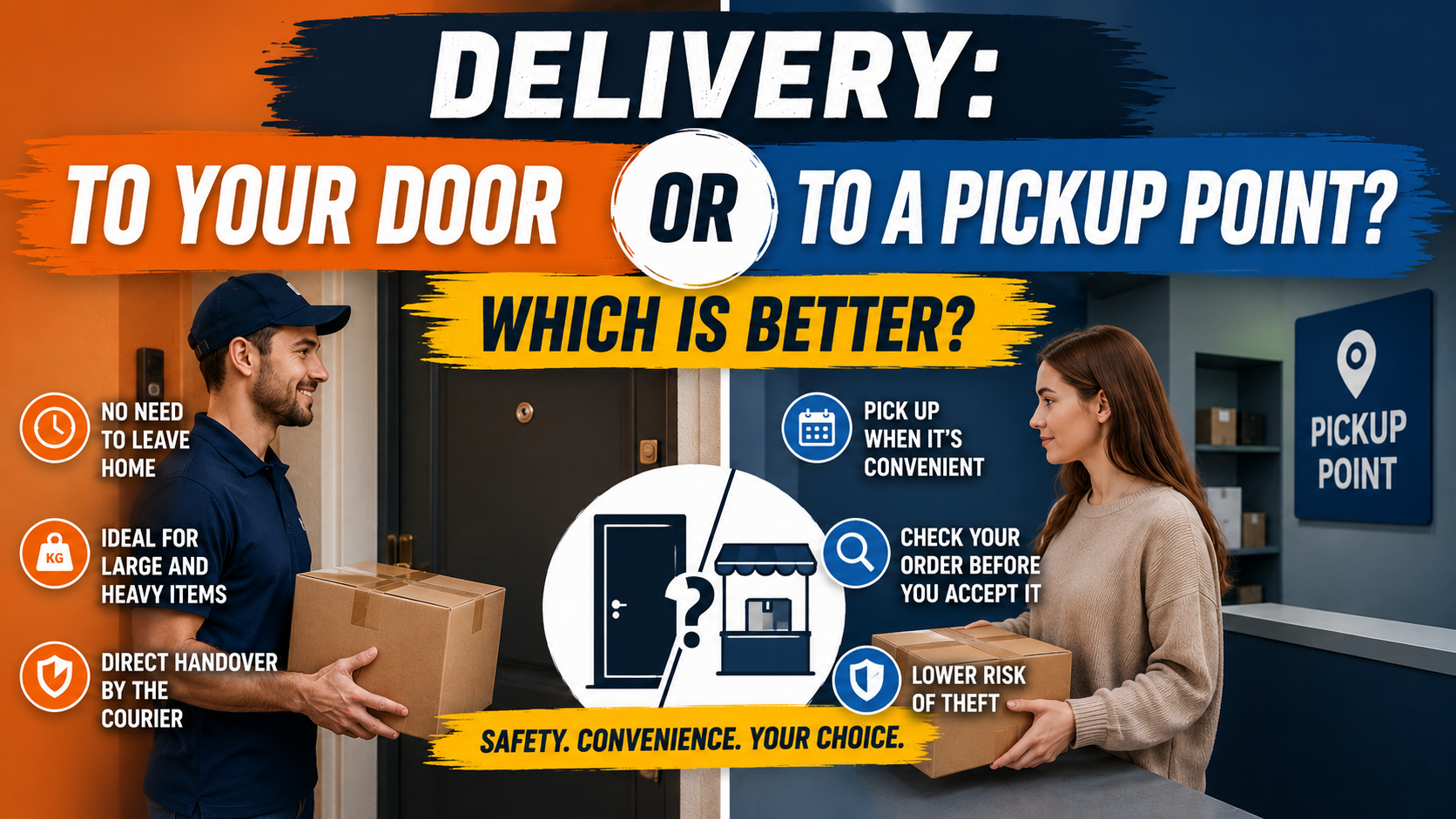
The order can be received from the courier or picked up at the pickup point. At first glance, the only difference is whether you have to leave the house. In practice, the method of receipt affects the safety of the goods, the ability to calmly inspect the packaging, and the chances of quickly filing a complaint.
Courier delivery to the door is suitable for people with a tight schedule, parents with small children, elderly customers, and those who order heavy items. The pickup point is more convenient when the recipient does not know when they will be home or wants to check the goods without haste.
How receiving from a courier differs from pickup at a branch
With door-to-door delivery, the package is delivered to a specific address. The recipient is assigned a time slot or called shortly before arrival. Sometimes the courier asks for a code from the message, to show a document, or to sign.
At the branch or pickup point, the order is stored for several days. The customer comes at a convenient time, provides the code, presents their passport if necessary, and picks up the shipment. Many points have a table for unpacking, a camera, and a socket for quickly checking the equipment.
| Criterion | Door-to-door delivery | Pickup at a branch or pickup point |
|---|---|---|
| Convenience | No need to go anywhere | You can come within the storage period |
| Time control | You have to wait for the courier | The recipient chooses the time |
| Inspection of goods | Often happens quickly, at the door | Usually can be checked without haste |
| Heavy orders | The courier will bring it to the house or apartment | The package will have to be carried by yourself |
| Risk of transfer to another person | Higher when left at the door | Lower when issued by code or document |
| Damage recording | Depends on the courier's regulations | Video recording of the pickup area is often conducted |
Advantages of courier delivery
The main advantage is saving effort. Water, pet food, household appliances, furniture parts, and other heavy purchases arrive directly at the address. There is no need to look for parking, stand in line, or drag a box across half the city.
Courier delivery also has other advantages:
-
it is suitable for people with limited mobility;
-
it simplifies receiving large orders;
-
it helps save time on the road;
-
it allows you to receive urgent purchases at home or in the office;
-
it reduces the risk of damaging the goods during self-transportation.
A good courier sends a tracking number, employee details, and an approximate arrival time in advance. The recipient understands who is delivering the order and when to expect a call. If the service shows the vehicle's movement on the map, planning the day is even easier.
The downside is also noticeable: the time interval can stretch for several hours. The courier was delayed at previous addresses—the schedule is disrupted. The customer has to stay in place, even if the delivery takes two minutes.
When the branch is more convenient
The pickup point wins due to predictability. The package is already in place, and the client comes after work, school, or on the way home. This option is especially useful for people who are rarely home during the day.
At the pickup point, it is easier to conduct the initial acceptance:
-
Inspect the box from all sides.
-
Check seals, tape, and protective stickers.
-
Compare the weight of the shipment with the data on the label.
-
Open the packaging under the camera when the site rules allow it.
-
Check the completeness and appearance of the goods.
-
Record defects before leaving the point.
For expensive electronics, this scenario is often calmer. At the door, the courier may be in a hurry, while at the branch, there is normal lighting and a flat surface. However, not every pickup point allows you to turn on the device or open the factory packaging before confirming receipt. It is better to check the rules in advance.
Where the risk of theft is higher
The riskiest option is contactless delivery with leaving the order at the door, in the entrance, or near the gate. A neighbor, a random visitor to the house, or someone watching the couriers can take the box. Open stairwells and private homes without cameras are especially vulnerable.
The risk increases if:
-
the courier leaves the package without the recipient's direct consent;
-
the packaging shows the brand of an expensive item;
-
the entrance is not locked;
-
the order is left unattended for a long time;
-
the delivery photo does not show the exact location;
-
the confirmation code is shared over the phone in advance.
Do not give the code before you see the courier and the package. Such a code often confirms receipt. After its transfer, it is harder to dispute with the service: the system may mark the order as delivered.
At the branch, the likelihood of ordinary theft is lower. The issuance is conducted by barcode, one-time password, or document, and the premises are monitored by staff and cameras. Problems may arise due to code leakage, operator error, or account fraud, but this is a less typical scenario than a box disappearing from the entrance.
Where packages are more often damaged
Most damages occur not in the last meter of the route, but during sorting, reloading, and transportation. Boxes fall from the conveyor, are pressed by heavy shipments, get wet, or receive punctures. The method of receipt affects not so much the fact of damage itself, but the ability to notice it in time.
With courier delivery, the box may be additionally crushed in the vehicle if the load is poorly secured. The branch has another weak point: packages are stored on shelves, moved by staff, and sometimes stacked on top of each other.
Warning signs:
-
torn or re-stuck tape;
-
dents on the corners;
-
wet spots;
-
holes in the cardboard;
-
the sound of broken glass;
-
an unusually light box;
-
signs of seal tampering.
Do not agree to "accept first, then check" when the packaging is clearly damaged. Ask to document the condition of the shipment with an act, photo, or note in the app. For expensive orders, record the unboxing in one shot: the label, closed box, seals, the process of opening, and the contents should be captured in the video.
How to choose the right method
It makes sense to call a courier for heavy, bulky, and inexpensive items that are difficult to transport by yourself. Hand-to-hand transfer is safer than allowing a box to be left at the door. For electronics, jewelry, collectibles, and other expensive purchases, it is better to choose a pickup point with cameras and the ability to inspect.
Follow a simple rule:
-
heavy and large — to the door;
-
expensive and fragile — to the branch with inspection;
-
urgent — according to the actual service timelines;
-
confidential — only with personal handover;
-
inexpensive and everyday — by any convenient method.
Safety also depends on the recipient themselves. Check the address, do not share the code with strangers, enable notifications, and track the shipment. When handing over, inspect the packaging before confirming. These actions take a couple of minutes but significantly reduce the risk of being without the goods and without evidence.
Door-to-door delivery wins in comfort, especially for heavy orders. The branch offers more freedom in timing and is calmer for checking the contents. When the purchase price is high, choose not the fastest option, but the one where it is easier to document the condition of the package and immediately file a complaint in case of a problem.