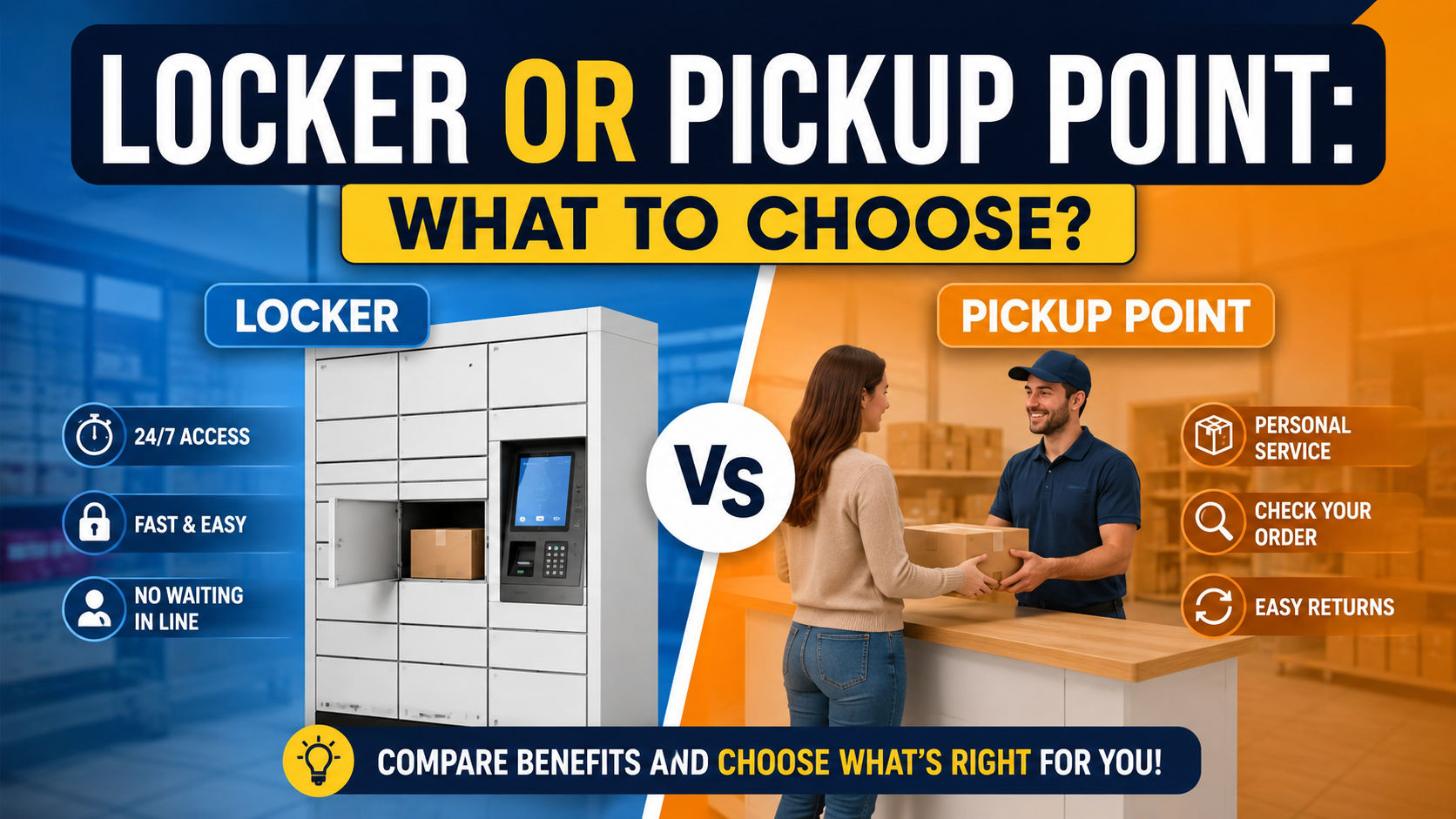
Receiving an order is no longer limited to meeting with a courier. Online stores offer delivery to a pickup point or an automatic parcel locker, which is often referred to as a postamat. Both options allow you to pick up your purchase near your home, but they work differently.
The main difference is simple: at the pickup point, an employee hands over the order, while in the parcel locker, the customer independently opens the compartment using a code or an app. This detail affects the speed of receipt, the possibility of trying on, the allowable size of the parcel, and the return process.
How a parcel locker differs from a pickup point
A parcel locker is an automatic terminal with compartments for storing parcels. They are installed in shopping centers, supermarkets, entrances, business centers, and gas stations. There is usually no employee nearby: the system checks the code itself and opens the necessary door.
A pickup point is a full-fledged delivery point where an operator works. They find the order, check documents or codes, help inspect the goods, and process returns. Some points have fitting rooms, unpacking tables, and outlets for quick testing of electronics.
The difference between a postamat and a pickup point is especially noticeable when receiving clothing, electronics, and bulky purchases. A small box with accessories can be conveniently picked up from the compartment in a minute. A jacket, shoes, or smartphone can be checked more calmly with an employee present.
Comparison of parcel lockers and pickup points
| Criterion | Parcel Locker | Pickup Point |
|---|---|---|
| Speed of receipt | Usually 1–3 minutes | Depends on the queue |
| Working hours | Often until late evening or 24/7 | According to the point's schedule |
| Communication with an employee | Not required | Required |
| Trying on | No | Often available |
| Product inspection | Limited by platform conditions | Usually available |
| Large parcels | Do not fit in the compartment | More often accepted |
| Return | Not available in all networks | Usually processed on-site |
| Assistance with problems | Through support | You can contact the operator |
| Storage period | Often 2–5 days | Usually 5–14 days |
The exact conditions depend on the store and the delivery service. The same parcel locker can dispense parcels from several operators, but the storage periods, compartment sizes, and return rules will differ.
When it is more convenient to choose a parcel locker
A parcel locker wins where speed is needed. You don't have to wait for an employee to find the box in the warehouse, scan the code, and prepare the handover. Enter the numbers, open the compartment, pick up the order. Done.
This method is suitable if:
-
the parcel is small and light;
-
the item does not need to be tried on;
-
the order has already been paid;
-
the point is on the way home or to work;
-
the customer finds it inconvenient to adjust to the pickup point's schedule;
-
there is no desire to stand in line during peak hours.
Automatic handover is especially convenient for books, cosmetics, chargers, household items, home goods, and other purchases that are rarely checked on-site.
There is a nuance. If the terminal is located inside a store or shopping center, you won't be able to pick up the box at night, even when the service states that the machine operates 24/7. You need to rely on the facility's schedule.
How to use a parcel locker
The process depends on the specific operator, but the general scheme is almost the same everywhere.
-
When placing an order, choose delivery to a parcel locker.
-
Find a suitable point on the map.
-
Wait for a notification about the arrival of the parcel.
-
Approach the terminal before the storage period expires.
-
Enter the code from the SMS or open the compartment through the app.
-
Take the box and close the door tightly.
Some terminals may ask to confirm the phone number, scan a QR code, or pay for the order with a bank card on the screen. Cash is almost never accepted by the machines.
The pickup code cannot be forwarded to others. A person who receives the combination of numbers will be able to open the compartment without a passport. If the message is accidentally deleted, the code is usually restored through the app or the delivery service support.
Before leaving, check the tracking number and the condition of the packaging. If the door opened and the compartment is empty, do not press the confirmation of receipt. Immediately take a photo of the screen and call support. The same rule applies if the box is opened or heavily damaged.
What to do if the compartment does not open
First, re-enter the code and check if the storage period has expired. Sometimes the door is held by a tightly packed box—after the command to open, it can be gently pulled towards you.
If the terminal is frozen, do not try to force open the compartment. The support number and the machine's identifier are usually indicated on the body. The operator will restart the command remotely or create a request for a technician to come out.
When it is better to receive an order at a pickup point
A pickup point is more convenient for items that need to be inspected before final receipt. In the fitting room, you can assess the size and fit of clothing, compare several pairs of shoes, check completeness, and refuse an unsuitable item.
A pickup point is better to choose in the following cases:
-
the order consists of several items;
-
trying on is needed;
-
it contains fragile or expensive electronics;
-
the purchase is large;
-
partial payment is required;
-
there is a risk of returning the item;
-
the customer needs assistance from an employee.
When receiving electronics, you can inspect the casing, verify the serial number, and check if the device turns on. A full diagnosis will not be allowed, but obvious damage, incompleteness, or substitution can be noticed immediately.
The downside of a pickup point is the potential queues. The points are most crowded in the evening, on weekends, and during major sales. If the order has already been paid and inspection is not needed, going for a small box sometimes takes longer than the actual travel time.
Pros and cons of both options
Parcel Locker
Pros:
-
fast handover without a queue;
-
minimum contacts;
-
easy access via code;
-
many points in residential areas;
-
convenient schedule.
Cons:
-
no fitting room;
-
compartment size is limited;
-
no one to ask questions immediately;
-
short storage period;
-
return through the terminal is not always available.
Pickup Point
Pros:
-
you can inspect the order;
-
trying on is often available;
-
the operator helps with handover and returns;
-
large boxes are suitable;
-
storage period is usually longer.
Cons:
-
there can be queues;
-
the point operates on a schedule;
-
more time is spent on receipt;
-
the quality of service depends on the specific point.
How to choose the right delivery method
For a small pre-paid purchase without trying on, a parcel locker is more practical. It saves time and allows you to pick up the box without unnecessary actions. The main thing is to make it before the end of the storage period and check the access mode to the terminal in advance.
For clothing, shoes, electronics, fragile items, and expensive orders, a pickup point is more reliable. The employee is not responsible for the quality of the purchase, but it is easier to document packaging damage, refusal of goods, or missing parts in their presence.
It is useful to consider not only the distance to the point. A parcel locker in the neighboring building may turn out to be inconvenient if the parcel is stored for only two days. A pickup point a little further away may be better when the order can be picked up within a week and calmly checked on-site.
There is no universal winner. A parcel locker excels in speed and autonomy, while a pickup point offers the possibility of trying on, inspection, and live assistance. For everyday small items, a compartment is suitable, while for purchases with a risk of return, a regular handover through an operator is preferable.