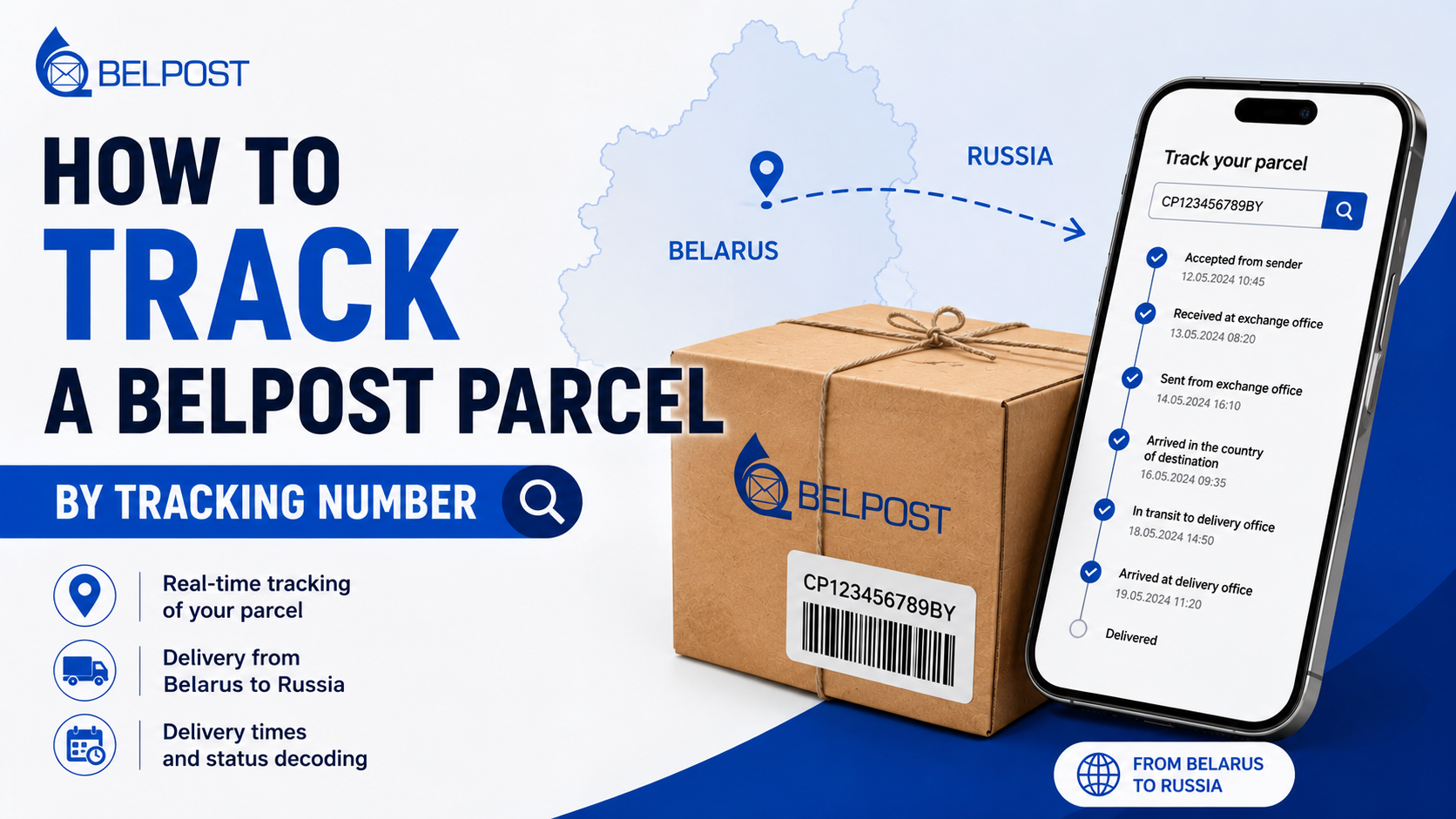
Parcels of Belpost are tracked by the postal identifier — the tracking number, which the sender receives after the shipment is processed. It allows you to see the acceptance of correspondence, movement between sorting centers, transfer to another postal service, and delivery to the addressee.
The check takes less than a minute. Difficulties usually arise not with the search itself, but with deciphering the statuses: the record may not change for several days, the shipment suddenly disappears from the Belarusian system, or is listed as transferred to the destination country. Let's figure out what this means in practice.
Where to find the Belpost tracking number
The identifier is indicated on the cash receipt, the receipt, or in the electronic message if the sender arranged the shipment online. Online stores often place the code in the customer's personal account.
Registered international shipments usually use a 13-digit number of the S10 standard. It consists of two Latin letters, nine digits, and two more letters indicating the country of dispatch. For a parcel from Belarus, the last characters most often look like BY.
Examples of the format:
-
RR123456789BY— registered written shipment; -
CP123456789BY— international parcel; -
EE123456789BY— EMS expedited mail shipment; -
LA123456789BY— tracked small package.
The set of letters depends on the category and service. Determining the type of parcel solely by the first pair of characters is not always accurate: the operator may use different ranges of codes.
If the seller sent a long order number without letters, it may be an internal store code. For belpost tracking, you need the postal identifier.
How to track a Belpost parcel
To track a Belpost parcel, open the official service of the operator and find the shipment tracking section. Then follow these steps:
-
Copy the tracking code from the receipt or the seller's message.
-
Paste it into the search bar without spaces.
-
Check if the letters and numbers are mixed up.
-
Start the search.
-
Look at the last event, date, and processing location.
The case of letters usually does not affect the result, but it is more reliable to enter the code in Latin in its original form. A common mistake is the confusion between the letter O and the digit 0, the characters I and 1.
If a parcel is sent from Belarus to Russia, after crossing the border, the data may appear in the Russian Post system. The Belarusian operator shows the stages on its side, while the Russian one shows further sorting and delivery to the recipient. Sometimes both systems display the same chain of events, sometimes one updates faster.
What the main statuses mean
The formulations may differ, but the logic of movement remains the same.
| Status | What happens to the shipment |
|---|---|
| Accepted from the sender | The parcel has been processed and handed over to the postal operator |
| Arrived at the exchange institution | The shipment has arrived for international mail sorting |
| Sent from the exchange institution | The parcel has left the sorting hub |
| Transferred to the carrier | The cargo has been prepared for transportation between countries or regions |
| Arrived in the destination country | The shipment has been registered by the operator of the receiving country |
| Directed to the delivery location | The parcel is on its way to the local post office |
| Arrived at the post office | The shipment can be collected after notification or status update |
| Delivered | The recipient has picked up the parcel or it has been handed over to an authorized person |
The status "sent from the country of dispatch" does not mean that the parcel has already physically crossed the border. Often, the record appears after the postal container is closed, while the actual transportation begins later.
The record "arrived in the destination country" can also be delayed. There is a time gap between unloading, scanning the bag, and registering each shipment. Postal workers call this interval the tracking blind spot: the parcel is moving, but there are no new scans yet.
How long does it take for a parcel to go from Belarus to Russia
There is no single timeframe for all destinations. The speed is influenced by the city of dispatch, the recipient's region, the category of shipment, the load of sorting facilities, and the transport scheme. Official operators recommend calculating the timeframe for specific addresses and types of shipments using a postal calculator.
For a regular registered parcel, you can use a practical guideline:
| Stage | Typical range |
| Acceptance and initial sorting in Belarus | 1–3 working days |
| International processing and transportation | 2–7 days |
| Sorting on the territory of Russia | 2–6 days |
| Delivery to the recipient's post office | 1–5 days |
| Total guideline | 7–20 days |
This is not a guaranteed standard. Shipments to Moscow, St. Petersburg, and regions neighboring Belarus often arrive faster. Delivery to the Far East, a small settlement, or a remote area takes more time.
EMS usually goes faster due to priority processing. Simple and budget shipments may move slower. Before holidays, sorting facilities often experience a backlog, so it is reasonable to add a few days to the estimated timeframe.
Why tracking is not updated for a long time
A pause in movement does not always indicate a loss. Some operations occur without individual scanning. For example, a bag is already moving between sorting hubs, while the record for a specific parcel remains unchanged.
The most common reasons:
-
The shipment is waiting for the formation of a transport batch;
-
The intermediate hub did not transmit data immediately;
-
The parcel is moving by ground transport;
-
There was a delay in sorting;
-
The address or index requires manual verification;
-
The information between the Belpost and Russian Post systems is synchronized with a delay;
-
The sender issued the tracking number in advance but has not yet handed over the package to the postal workers.
After the electronic waybill is issued, the number already exists, although the physical box may still be with the seller. In such a situation, the system shows that the data has been received, but the acceptance of the shipment is not confirmed.
What to do if the parcel is stuck
First, check the tracking in both systems — Belpost and the operator of the destination country. For shipments to the Russian Federation, it is useful to check the data of the Russian Post: after import, newer scans sometimes appear there.
Next, assess the duration of the pause:
-
up to 3–5 days between sortings — a normal situation;
-
more than a week without movement — a reason to clarify information with the sender;
-
The timeframe has significantly exceeded the estimated — you can submit a search request.
The search for an international shipment is usually initiated by the sender. They have the receipt, the acceptance date, the category of shipment, and information about the contents. It is better for the recipient to request a photo of the receipt in advance and ensure that the surname, index, and address are correctly indicated.
Belpost assigns a unique 13-digit identifier to registered international shipments, which is used to check the movement of correspondence. If the seller does not provide such a code, full tracking may be unavailable.
When can you go to the post office
Focus on the record of arrival at the post office or readiness for issuance. The mere fact of arrival in the city does not yet mean that the box has been unpacked and processed in the database.
For collection, you usually need an identity document and the shipment number. In some cases, Belpost allows the use of an SMS or QR code if the service is available for a specific parcel and the recipient's data is correctly indicated.
Do not delay your visit. Postal shipments have a limited storage period, after which they are returned to the sender. The exact timeframe depends on the category of shipment and the services connected.
It is most reliable to monitor the route by tracking number rather than waiting for a paper notification. Check both postal systems, consider pauses between scans, and keep the receipt until delivery. This makes it easier to distinguish between a normal delay and a situation when it is already time to initiate a search.